 EN
EN


Innovative Submerged Ultrafiltration for Glass Industry Wastewater Treatment
Introduction to Glass Wastewater Challenges
In the glass deep processing industry, wastewater generated from core processes such as cutting, edge grinding, and cleaning contains high-concentration suspended solids, fine glass powder, trace organic pollutants, and residual chemicals. This wastewater is characterized by complex and fluctuating water quality, posing significant challenges for environmental governance in the industry.
Drawbacks of Traditional Water Treatment
Traditional water treatment processes suffer from:
-
Large Floor Space: The need for significant infrastructure and equipment.
-
High Energy Consumption: Traditional systems often demand substantial energy resources.
-
Weak Pollution Resistance: Difficulty in handling high-density pollutants and varying water qualities.
-
Low Reuse Rates: Making it challenging for companies to meet both environmental compliance and cost-reduction goals.
Dinghui Environmental Protection’s Innovation
Submerged Ultrafiltration (iUF) System
Hangzhou Dinghui Environmental Protection Technology Co., Ltd. has launched an innovative Submerged Ultrafiltration (iUF) system after over a decade of research and development. The iUF system has overcome industry dilemmas with multiple technological breakthroughs, providing a benchmark solution for wastewater treatment and reuse in glass deep processing.
Key Features of the Submerged Ultrafiltration System
-
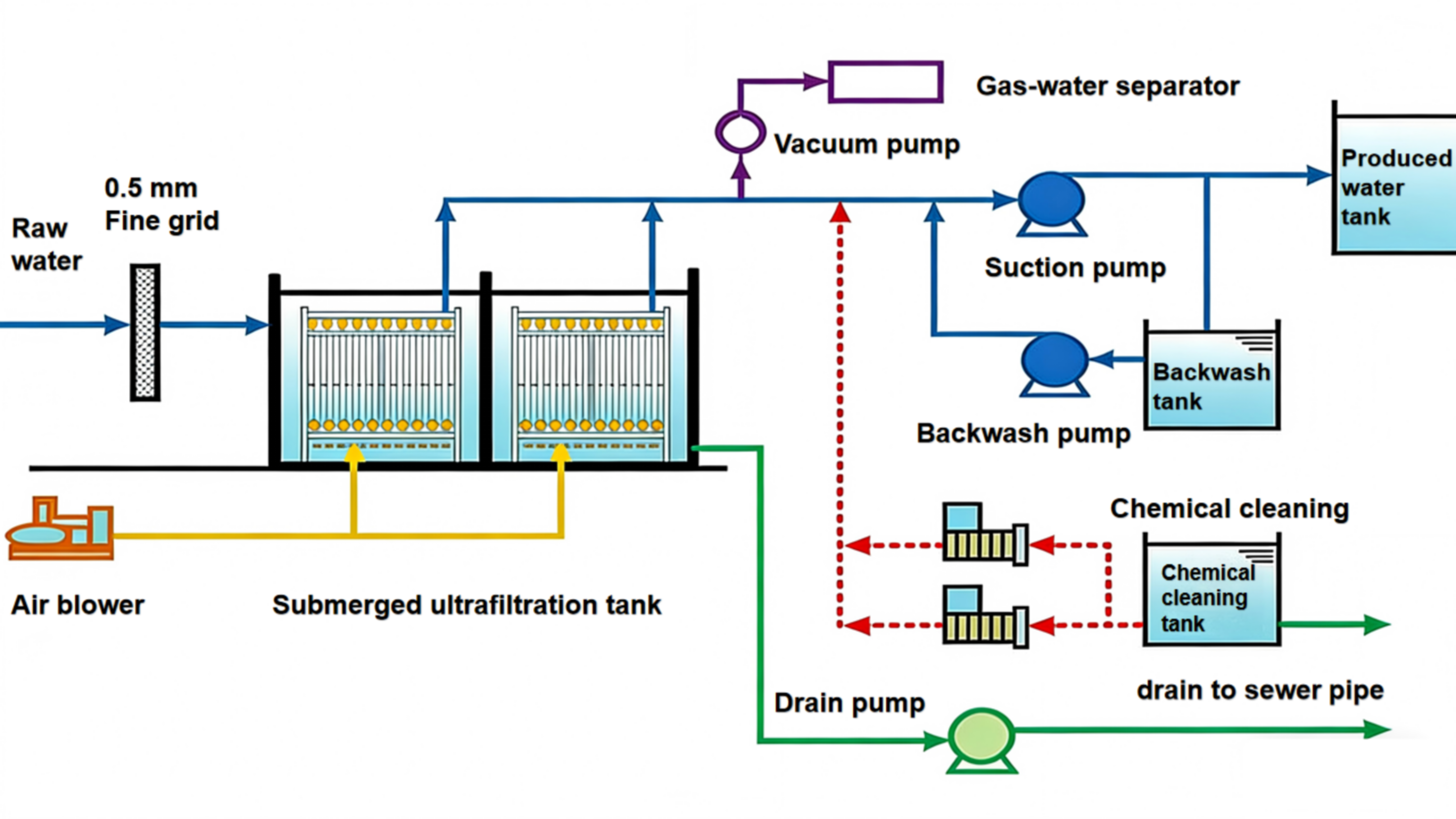
Innovative Ultrafiltration Technology: The iUF system directly immerses membrane modules into a membrane tank filled with water to be treated. By generating negative pressure, it draws water through the membrane, retaining macromolecular pollutants and suspended solids.
-
Water Quality Classification + Precise Treatment: The system innovatively handles different water qualities:
-
Front-End Water: High suspended solid concentration (from cutting, edge grinding, and pre-cleaning).
-
Back-End Water: Low suspended solid concentration (from pure water cleaning).
The system applies precise treatment after pretreatment for front-end water, while back-end water enters the system directly for treatment.
-
Unique Composite Treatment System
Integration with Water Purification Materials
To address the limitation of pure ultrafiltration, Dinghui Environmental Protection has integrated a composite treatment system into the iUF system:
-
Suspended Water Purification Material: A special material developed for glass deep processing wastewater that efficiently adsorbs ionic pollutants such as organic pollutants and organic solvents.
-
Water Separation via Membrane Filtration: The purification material is separated from the water using membrane filtration, ensuring that treated water meets the requirements for various processes in the glass industry.
Backwashing System
The iUF system features an automated backwashing program to maintain membrane performance:
-
Methods: Water backwashing, aeration scrubbing, and chemical backwashing to remove pollutants from the membrane surface.
-
Closed-Loop Operation: The system discharges waste liquid after backwashing, re-injects raw water, and starts the next water production cycle.
Operational Efficiency and Cost Benefits
Low Energy Consumption and High Efficiency
-
Energy Consumption: The suction pump consumes only 0.03~0.06 kWh/m³ of energy.
-
Optimized Air-Water Ratio: The air-water ratio of 8-12:1 ensures low energy consumption while maintaining high efficiency.
-
Cost-Effective: The treatment cost per ton of water is as low as 0.15 yuan, much lower than traditional cylindrical pressure-type ultrafiltration.
Membrane Module Design
-
Reinforced Structure: The membrane module features a lining-reinforced structure and soft rubber root protection, offering stronger pollution resistance and permanent hydrophilicity.
-
Effective Filtration: The membrane has a sponge structure with a controlled pore size of 0.05 microns, effectively retaining fine glass powder and ensuring that the turbidity of produced water stays below 1 NTU, with SS content below 10 mg/L.
-
Chemical Resistance: The module can withstand cleaning with sodium hypochlorite (5000 mg/L) and reverse water pressure of up to 0.3 MPa, extending the service life and reducing maintenance costs.
Compact Design and Easy Maintenance
Compact and Space-Efficient
-
Small Floor Space: The system’s compact structure and high membrane packing density reduce the required floor space compared to traditional systems.
-
Easy Installation and Maintenance: The equipment is designed with quick-release interfaces, allowing maintenance to be completed in just 10 minutes. Some models come with universal wheels for easy movement.
Pollution Resistance
The system is shock-load resistant and can adapt to a wide range of water quality fluctuations, making it suitable for various wastewater types in the glass industry.
Water Reuse and Environmental Benefits
Water Reuse Efficiency
-
Reuse of Back-End Water: The system allows for the reuse of back-end water, reducing tap water consumption by up to 80%. This contributes to a significant reduction in operational costs and improves water conservation efforts.
Zero-Discharge Design
The zero-discharge design of the system contributes to sustainability:
-
Closed-Loop Water Recycling: All treated water is reused in the production process, reducing environmental impact and water waste.
Return on Investment (ROI)
Enterprises can recover their investment within 8 to 13 months due to the significant reduction in water and energy consumption, making the system an excellent economic and environmental solution.
Company Introduction
We specialize in the R&D, consultation, engineering contracting, and equipment installation of wastewater treatment and reuse technologies for glass deep-processing.
Over the past 17 years, the company has accumulated abundant engineering experience in water treatment and recycling for the glass deep-processing industry. Our R&D team consists of 1 professor-level researcher, 2 postgraduate-degree holders, 5 intermediate engineers, and 4 Class II registered construction engineers. Guided by the principle of integrity in conduct and steadiness in work, we have gained profound insights into the application of water treatment technologies in the glass deep-processing sector through years of practice, thus creating a path of win-win cooperation in the fields of wastewater treatment, reclaimed water reuse engineering, construction, installatio,n and services.
The company has long carried out technical cooperation and R&D with renowned domestic universities, striving to transform scientific and technological achievements into high-automation, superior-quality products that cater to customers of various demands. We are committed to establishing a win-win cooperation model with clients by providing professional services and high-quality products, aiming to become their long-term and reliable strategic partners.
After years of in-depth research and development in the field of wastewater treatment and reuse equipment for glass deep-processing, Hangzhou Dinghui has successfully launched the 1st, 2nd and 3rd generations of integrated glass wastewater treatment equipment. These products have been widely applied in the domestic and overseas glass wastewater treatment and reuse systems of numerous leading enterprises, including Flat Glass Group Co., Ltd., China National Building Material Group Co., Ltd., Kibing Group Co., Ltd., CSG Holding Co., Ltd., Fuyao Glass Industry Group Co., Ltd., Yaopi Glass Co., Ltd. and Xinyi Glass Holdings Limited. The completed projects have been operating stably with high automation level. The treated wastewater can be recycled to meet the production water demand, which reduces the enterprise operation cost, conserves water resources and cuts down wastewater discharge. Meanwhile, various types of our edge-grinding wastewater treatment equipment and pure water preparation system equipment have obtained the CE certification.